

ART GALLERY (2026-) by MINT XXI
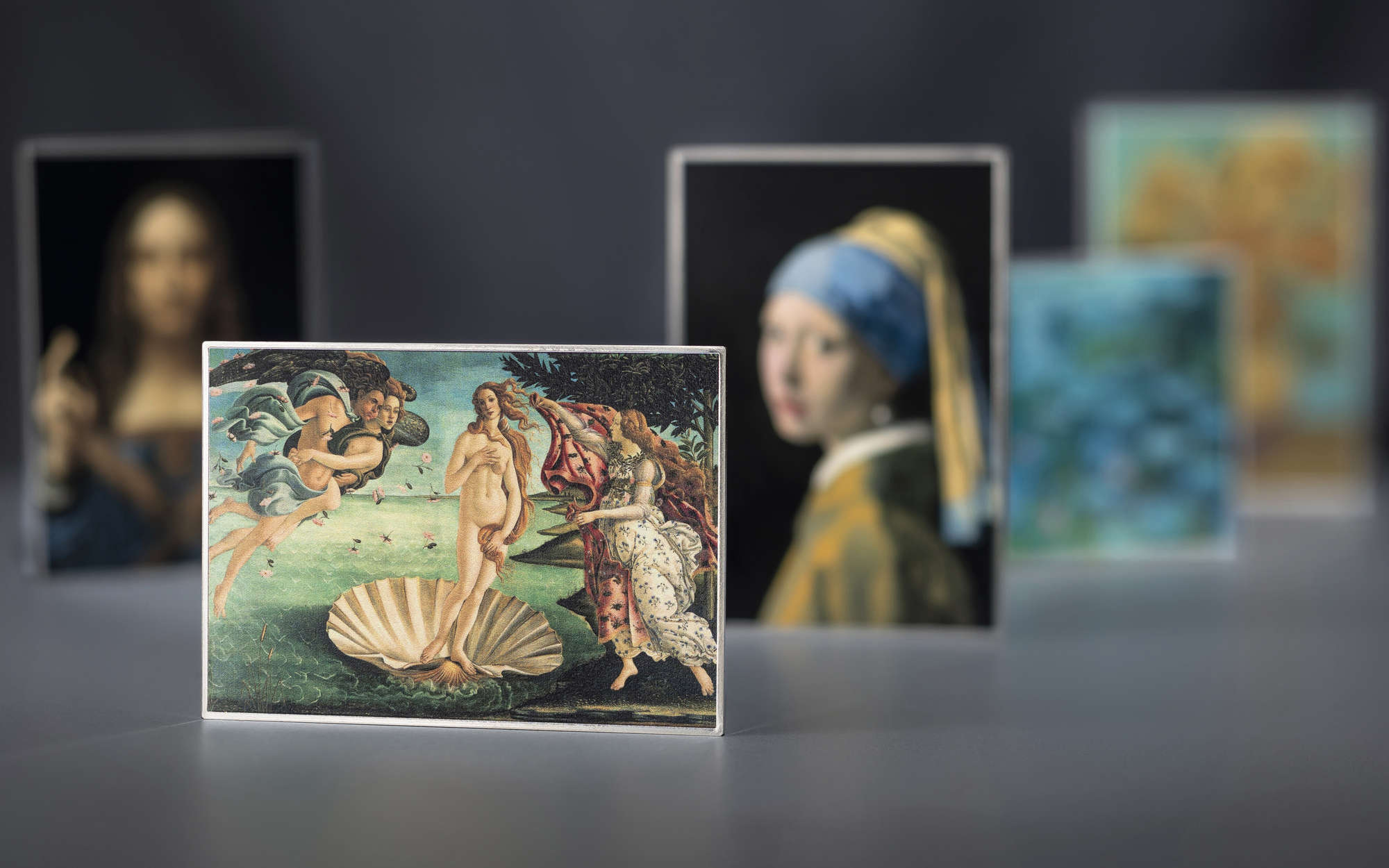
Art coins are common in the modern numismatic world, either reproducing original works, or creating original interpretations of them. Mint XXI’s series is called ‘Art Gallery’, and takes classic works of art, and reproduces them as closely as possible, on rectangular, one-ounce silver coins.
The coins, issued in batches of five, are large for their weight at 74 x 51.8 mm, with some in landscape format, and some in portrait. These aren’t flashy numismatics, preferring instead to focus on doing justice to the original works. Key to that is the colour, which has an extensive range, and utilises high-dimension digital printing, which they claim aims to ape the texturing of brushstrokes. It’s certainly clear from the images that the colour range is exquisite, keeping as much of the original nuance as possible.
Most of the first ten releases have had quite a bit of numismatic exposure before, but these will cater more to the fine art purist, who will appreciate a lack of tinkering. At an ounce in weight, they remain relatively affordable. A very on-target range in this genre, the subjects are wide enough that you can get them all, or just pick up the ones you like most, without feeling like you’re missing out. Hopefully, we’ll see some more unusual works put in an appearance, like Kateryna below. American Gothic, for example, or one of Holbein’s many portraits.
TABLE OF CONTENTS
2026 GIRL WITH A PEARL EARRING by Johannes Vermeer


The Girl With a Pearl Earring depicts a European girl wearing an exotic dress, an oriental turban, and a large pearl earring. The work is oil on canvas and is 44.5 cm high and 39 cm wide. It is signed “IVMeer” but not dated, and is estimated to have been painted around 1665. It resides in The Hague, at the Mauritshuis, where it has been since 1902.
Vermeer wasn’t prolific, with only 36 paintings having been attributed to him, but his mastery of lighting has made him a highly regarded, and this particular work, a ‘tronie’, is considered his masterwork. The dark background originally had a green hue, created using a glaze, but the organic pigments used have long faded.
2026 SALVATORE MUNDI by Leonardo da Vinci


The Salvator Mundi (“Saviour of the World”) is a painting generally attributed, either wholly or in part, to the Italian Renaissance master, Leonardo da Vinci, circa 1500. It depicts Christ giving a blessing with his right hand while holding a transparent, non-refracting crystal orb in his left, signifying his role as the ruler of the cosmos. Long believed lost, the panel painting was rediscovered in 2005, heavily overpainted, and subsequently underwent extensive restoration. Its authenticity as a work by Leonardo has been controversial among art historians, with some suggesting the master painted only specific passages or that it’s a work by his studio.
Despite the debates over attribution and its poor condition, the painting garnered worldwide attention when it was auctioned by Christie’s in New York in November 2017 for $450.3 million, setting a world record for the most expensive painting ever sold at public auction. It is one of fewer than 20 surviving paintings generally accepted as being from Leonardo’s own hand.
2026 SUNFLOWERS by Vincent van Gogh


Sunflowers is the name of two series of still life paintings by the Dutch painter Vincent van Gogh. He painted the first series, which depicted the sunflowers laying on the ground, while in Paris. The second series, painted a year later in Arles, has the sunflowers arranged in a vase, and it is this version that has achieved cult status in the art world.
Vincent Willem van Gogh was born 30 March 1853 and the Dutch post-impressionist painter went on to create around 2,100 artworks, including 860 oils, before his death by suicide at just 37 years of age. Most of his work, including landscapes, still lifes, portraits and self-portraits, were created in the last two years of a life marred by mental illness and poverty.
The definition of a troubled artist, van Gogh worked as an art dealer, travelling extensively in Europe, and it wasn’t until 1881, just 9 years before his death, that he took up painting. His work became characterised by bold colours and dramatic, impulsive and expressive brushwork, which became very influential in the modern art movement. Today, his work occupies a rarified place and many are amongst the most expensive works ever sold. The Van Gogh Museum in Amsterdam currently holds the world’s largest collection of his art.
2026 THE BIRTH OF VENUS by Sandro Botticelli


The Birth of Venus is a renowned painting by the Italian Renaissance artist Sandro Botticelli, completed around 1484-1486. It depicts the goddess Venus arriving at the shore after her birth, standing on a seashell in a composition that combines classical mythology with Renaissance artistic ideals. The central figure is the nude Venus, whose pose echoes classical sculpture, specifically the Venus Pudica type. To her left, the wind gods Zephyr (accompanied by Aura, or perhaps Chloris) blow her towards the land, scattering roses in their wake. To her right, a waiting nymph, often identified as Pomona or a Hora (Goddess of the Seasons), stands ready to cloak her with a richly embroidered mantle.
Commissioned by the Medici family, likely Lorenzo di Pierfrancesco de’ Medici, the work is celebrated for its ethereal beauty, idealised figures, and sensual yet academic portrayal of pagan subject matter. It’s an early example of painting on canvas in Tuscany and is now displayed in the Uffizi Gallery in Florence.
2026 WATER LILIES by Claude Monet


Undoubtedly one of the world’s great painters, Oscar-Claude Monet was the French painter that helped found, and gave the name to, the impressionist art movement. Impressionism has, as its central philosophy, the idea that art should take human perception, especially of nature, as a defining quality. They’re almost like snapshots, taking into account the interplay of light on the subject, and taking less formal perspectives.
One of Monet’s great passions was his garden in Giverny, Northern France, which had a huge garden with a water-lily pond. As a result, he took water lilies as a subject, producing over 250 paintings of them in the last 30 years of his life. They sit in many museums around the world, occasionally coming up for auction, where they attract huge attention, and massive sale prices, up to a staggering $54m.
2026 PRIMAVERA by Sandro Botticelli


Painted in the late 1470s/early 1480s, Primavera (‘Spring’ in Italian) is a huge painting of 3.14 x 2.02 metres, produced in tempera paint by Sandro Botticelli. The work is a collection of nine figures from antiquity in a woodland setting, who are, from right to left, Zephyrus grasping the nymph Cloris, Flora, Venus (set back from the others), the Three Graces, and then Mercury on the far left. A blindfolded Cupid hovers above. It’s am unusual mix by Renaissance standards.
The painting is remarkable for its botanical accuracy, and there are said to be over 500 plant species represented, including around 130 flower species. Obviously you won’t see that on the coin, which has the painting reduced from 3,140 mm to just 74 mm, but it’s astonishing regardless. The work may have been commissioned by one of the famous Medici family, and has spent most of its 550-year life hung in the same place as Botticelli’s other famous painting, The Birth of Venus, and that remains true to this day, as they both hang in the Uffizi Gallery in Florence,
2026 THE LAST SUPPER by Leonardo da Vinci


Another incredibly famous painting, The Last Supper is one of the few works finished by Leonardo da Vinci, and was completed in 1498. It was commissioned by Leonardo’s patron, Ludovico Sforza, the Duke of Milan, as part of the renovations to the Convent of Santa Maria delle Grazie, in Milan. The original painting, of which little remains, is 4.6 metres high, and a massive 8.8 metres wide, and is painted as a fresco, directly onto sections of wet plaster laid each day. This is one of the main reasons the work has degraded so badly, and required extensive, and only partially successful, restoration.
The Last Supper depicts the moment Jesus is said to have revealed which of his twelve apostles had betrayed him, and is a study in how each reacted to the news. It was a widely lauded work in its time, but soon deteriorated, so much so that in just 35 years, it was largely unrecognisable. It spent centuries being abused, and eventually underwent extensive restoration from 1978 to 1999, which remains controversial.
2026 KATERYNA by Taras Shevchenko


Taras Hryhorovych Shevchenko was a Ukrainian artist, poet, writer, and political figure, who lived from 1814 to 1847. While it was his poetry that garnered the most acclaim, his talent for painting drew attention, even from one of the most famous Russian painters of the time, Karl Briullov, who aided Shevchenko in gaining his freedom from serfdom. He was a controversial figure, pushing for the rights of Ukraine’s serfs oppressed by Russian nobility, and he eventually ran afoul of the Russian Emperor, Tsar Nicholas I, leading to exile to the military, and a ban on painting and writing. He was pardoned, but his latter years were unhappy.
Kateryna was painted in the summer of 1842, in oils on canvas, and was created to illustrate his own poem of the same name. The poem tells of the travails of a Ukrainian woman, seduced by a Russian, who leaves her to go to war. She has an illegitimate child, which is seen as dishonourable. Kateryna travels the road to Moscow, eventually finding the father, who refuses to recognise her. She leaves the child by the roadside, and drowns herself in a pond. Not a happy tale.
2026 THE KISS by Gustav Klimt


The Kiss (Lovers) was painted by the Klimt between 1907 and 1908, the highpoint of his “Golden Period”, when he painted a number of works in a similar gilded style. A perfect square, the canvas depicts a couple embracing, their bodies entwined in elaborate robes decorated in a style influenced by both linear constructs of the contemporary Art Nouveau style and the organic forms of the earlier Arts and Crafts movement.
The work is composed of oil paint with applied layers of gold leaf, an aspect that gives it its strikingly modern, yet evocative appearance. The painting is now in the Österreichische Galerie Belvedere museum in the Belvedere palace, Vienna, and is widely considered a masterpiece of the early modern period. It is a symbol of Vienna Jugendstil—Viennese Art Nouveau—and is considered Klimt’s most popular work.
2026 STARRY NIGHT by Vincent van Gogh


If any year could be described as a traumatic one for Dutch post-impressionist painter Vincent van Gogh, it would be 1889. On 23rd December 1888 he had a breakdown in which he undertook the famous self-mutilation of his left ear. Realising the danger, on 08 May 1889 he admitted himself to the Saint-Paul-de-Mausole lunatic asylum. Painted in early June 1889, Starry Night is his interpretation of the view from his east facing window of his asylum room at Saint-Rémy-de-Provence. It is depicted just before sunrise, and he has added what he considered to be an idealised village in the foreground.
The painting is a 737 x 921 mm oil on canvas and part of a prolific output from the period, which also included such highly regarded works as the Irises, and the blue self-portrait. The Starry Sky work currently resides in New York at the Museum of Modern Art, where it has done so since 1941. It is considered not only one of Van Gogh’s best works, but one of the finest in history.
2027 MONA LISA by Leonardo da Vinci


Leonardo di ser Piero da Vinci, 15 April 1452 – 2 May 1519), was an Italian polymath whose areas of interest included invention, painting, sculpting, architecture, science, music, mathematics, engineering, literature, anatomy, geology, astronomy, botany, writing, history, and cartography. His art is particularly admired. There are many examples of his art that have reached true iconic status. The Sistine Chapel ceiling, for example, or The Last Supper with its early use of perspective. The Vitruvian Man is another work that would sit at the top of any other artists portfolio, but for Leonardo, even that work takes a back seat to that cultural tour de force, the Mona Lisa.
A half-length portrait oil painting, said to be of Lisa Gherardini, the wife of Francesco del Giocondo, it was painted in the early 1500’s and after a succession of famous owners, was acquired by the Louvre in Paris, where it has resided since 1797. With the recent stupidity in auction prices for art such as this, it’s fair to say that if the Mona Lisa ever came up for sale, it would likely break the $1b barrier. Weirdly, it only really gained this level of fame after it was stolen from The Louvre in 1911 by an Italian patriot, only being returned in January 1914.
2027 VENUS OF URBINO by Titian


Titian was one of the great Italian Renaissance painters, known for his mastery of a wide range of subjects, including portraiture, landscapes, and the mythology and religion that was popular in the 16th century. He was popular throughout his lifetime, indeed, probably the defining artist for European nobility. His body of work was extensive, numbering over 300, with around 280 surviving today, as he continued painting up until his death aged around 88.
Venus of Urbino was completed in 1534, and depicts a nude woman, assumed to be the goddess Venus, reclining on a couch. It’s unusual for a Titian in having a detailed interior background. The painting gets its name from the Duchy of Urbino as Guidobaldo II della Rovere, the son of the Duke of Urbino, who purchased the painting. A 119 x 165 cm oil on canvas, it currently hangs in the Galleria degli Uffizi, in Florence.
2027 YOUNG WOMAN WITH IBIS by Edgar Degas


Like Monet, Edgar Degas was a French impressionist painter, and his contemporary, often showing works in the same exhibitions. Unlike Monet, Degas did not paint many landscapes, something often considered a core part of impressionism, preferring to concentrate on the human form, particularly dancers, who made up over half his portfolio.
Young Woman With Ibis, currently displayed by the Metropolitan Museum of Art in New York, is a 100 x 75 cm oil on canvas, painted in 1858, and reworked by Degas four years later. The rework included the addition of the Middle-Eastern city in the background, and the two red ibises that now give the work its name. The original image of a pensive woman now has a different feel to it.
2027 IMPRESSION, SUNRISE by Claude Monet


Claude Monet was the French painter that helped create, and gave the name to, the impressionist art movement. Impressionism has, as its central philosophy, the idea that art should take human perception, especially of nature, as a defining quality. He was widely admirer in his own lifetime, and was very prolific, producing hundreds of works.
One of the most important is Impression, Sunrise, which was credited with giving the movement its name. It was painted in 1874, one of six in a series depicting his home town, Le Havre. A 48 x 63 cm oil on canvas, it depicts the port of Le Havre at sunrise, and had mixed reviews on its debut at the ‘Exhibition of the Impressionists’ in Paris. The idea of painting an impression of a scene rather than the reality of it is now more understood, and Monet’s work is legendary today.
2027 THE MAIDEN by Gustav Klimt


Currently residing in the National Gallery in Prague in the Czech Republic, The Maiden was one of Klimt’s final paintings, finished in 1913, just five years before his early death at 55. After his extravagant ‘Gold Period’, his later works returned to a wider palette, full of intense colour and floral ornamentation.
This 1.9 x 2.0 metre oil on canvas depicts a woman in blue with spirals on her dress, interlaced with six other women. Each woman is meant to represent a different stage of life, especially with regards to love and sexuality. Whatever the case, a particularly vibrant, and much admired painting by an artist whose work commands phenomenal prices at auction.
OBVERSE & PACKAGING
The obverse is a common one to all coins in the series. At its centre is a circular area carrying the initials AG (Art Gallery) around what looks to be a symbolic picture frame, perhaps. The rest is filled with a ‘Zen Garden’ style pattern, on which is inscribed the issue details, twice.
The packaging consists of a solid acrylic block, with the two pieces held together magnetically. It comes in a black card box, with a Certificate of Authenticity.


| DENOMINATION | COMPOSITION | DIAMETER | FINISH | MINTAGE |
| 1,000 Francs CFA (Cameroon) | 31.1 g of 0.999 silver | 74.0 x 51.8 mm | Proof, Colour | 1,000 |
Leave A Comment