

Art Mint’s ‘Seven Ancient Civilisations’ 2oz silver coin collection jumps across the Atlantic to the Mesoamerican Maya culture
After wandering through the Middle East and Asia, Art Mint’s excellent Seven Ancient Civilisations series jumps over the Atlantic for its one and only visit to the Americas. The Mayan civilisation has its roots around 2,000 BCE, where the first villages, and signs of agriculture, appeared in a region that spread from southeastern Mexico, and encompassed much of Central America. The first cities were built around 750 BCE, and several well-known city states arose, like Tikal, and Chichén Itzá, both now major archaeological sites.
The Maya pushed boundaries in many areas, with mathematics, astronomy, writing, and architecture all seeing advances. This polytheistic culture suffered from internal wars between city states, particularly in the Classic Period after 250 CE, although it’s important to remember the Maya were never a monolithic empire, like the Romans for example. In 1511, the Maya made contact with Spanish explorers, and by 1697, the Spanish had basically subjugated the whole region. Despite that, the Mayan culture continues to exist to this day and many traditions are still practiced.
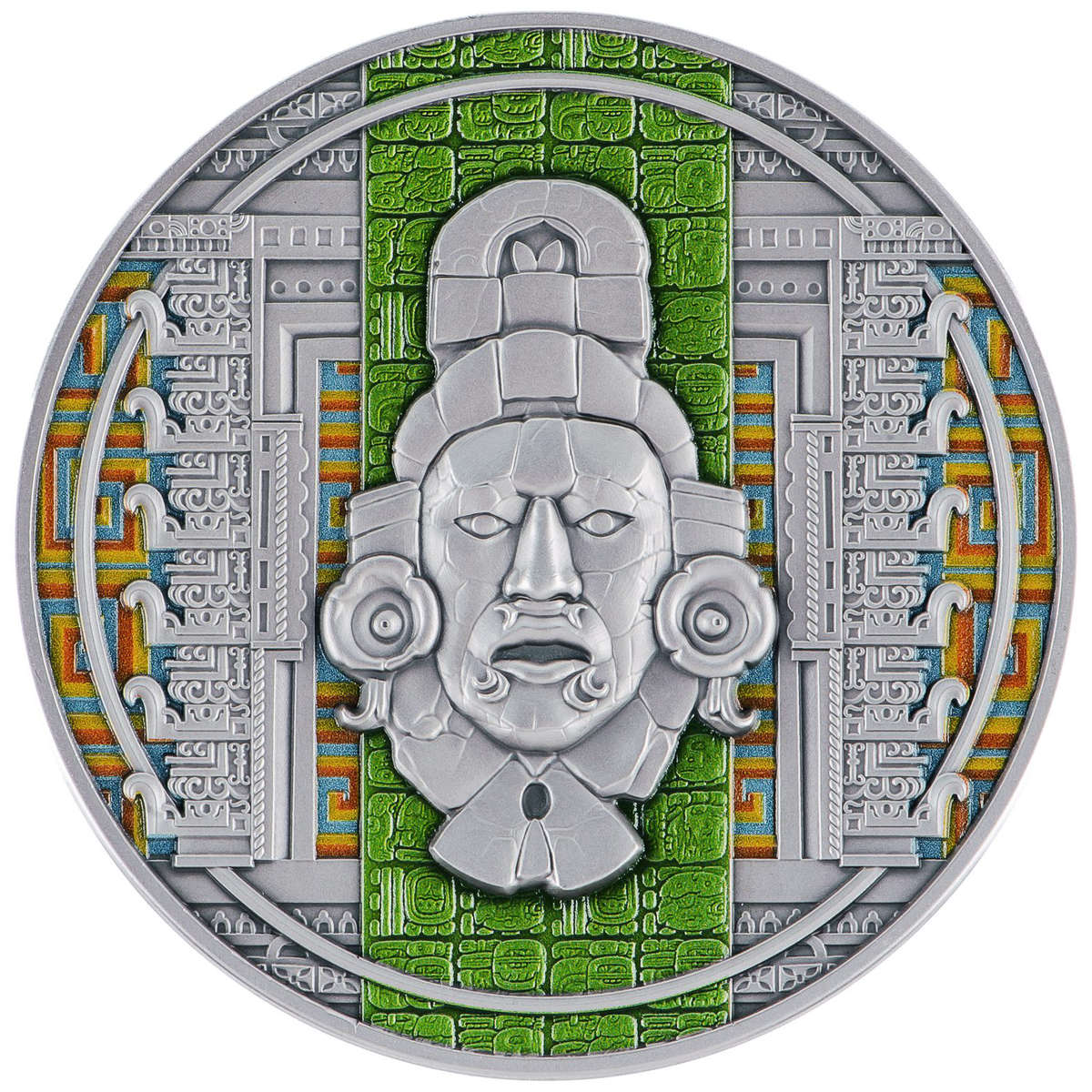

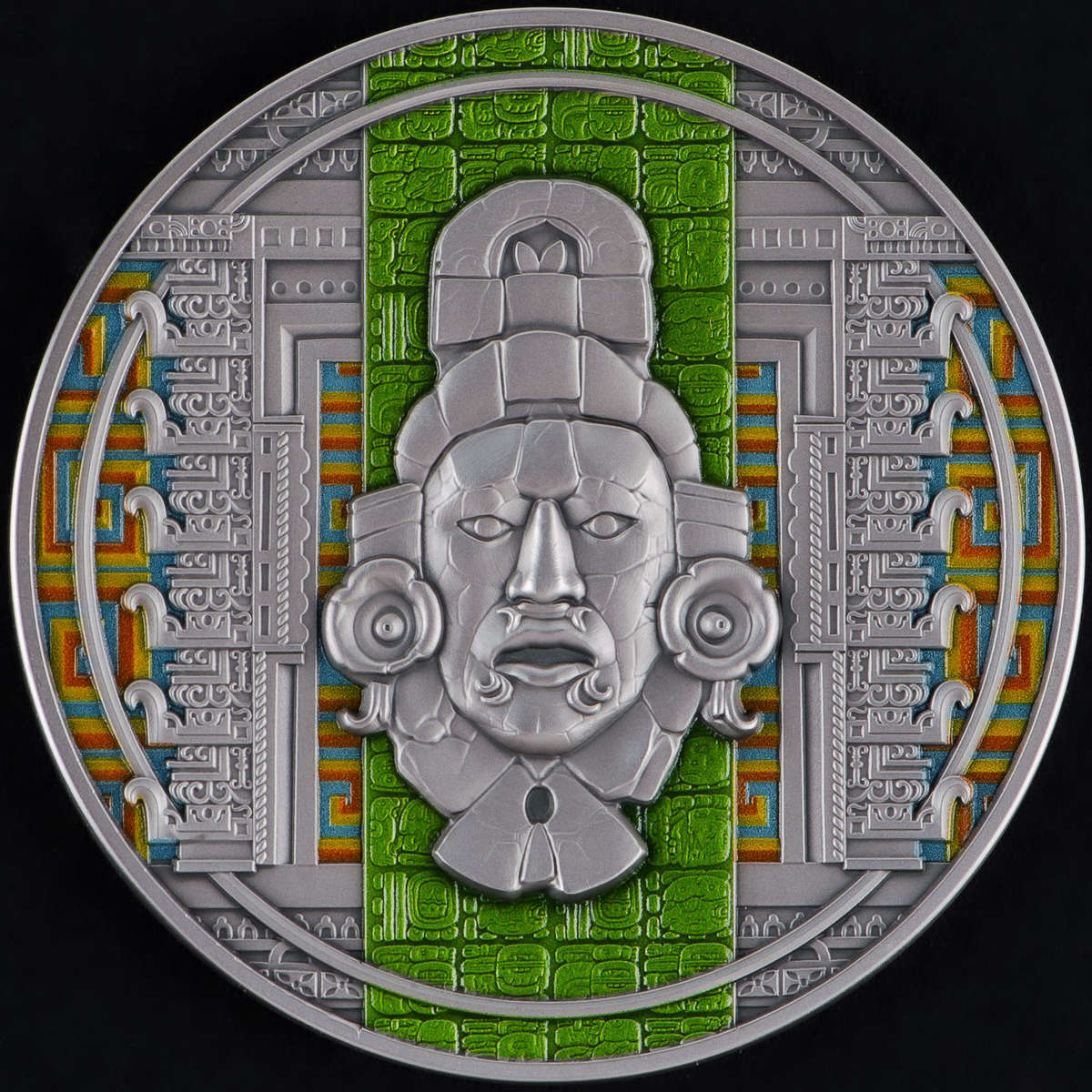
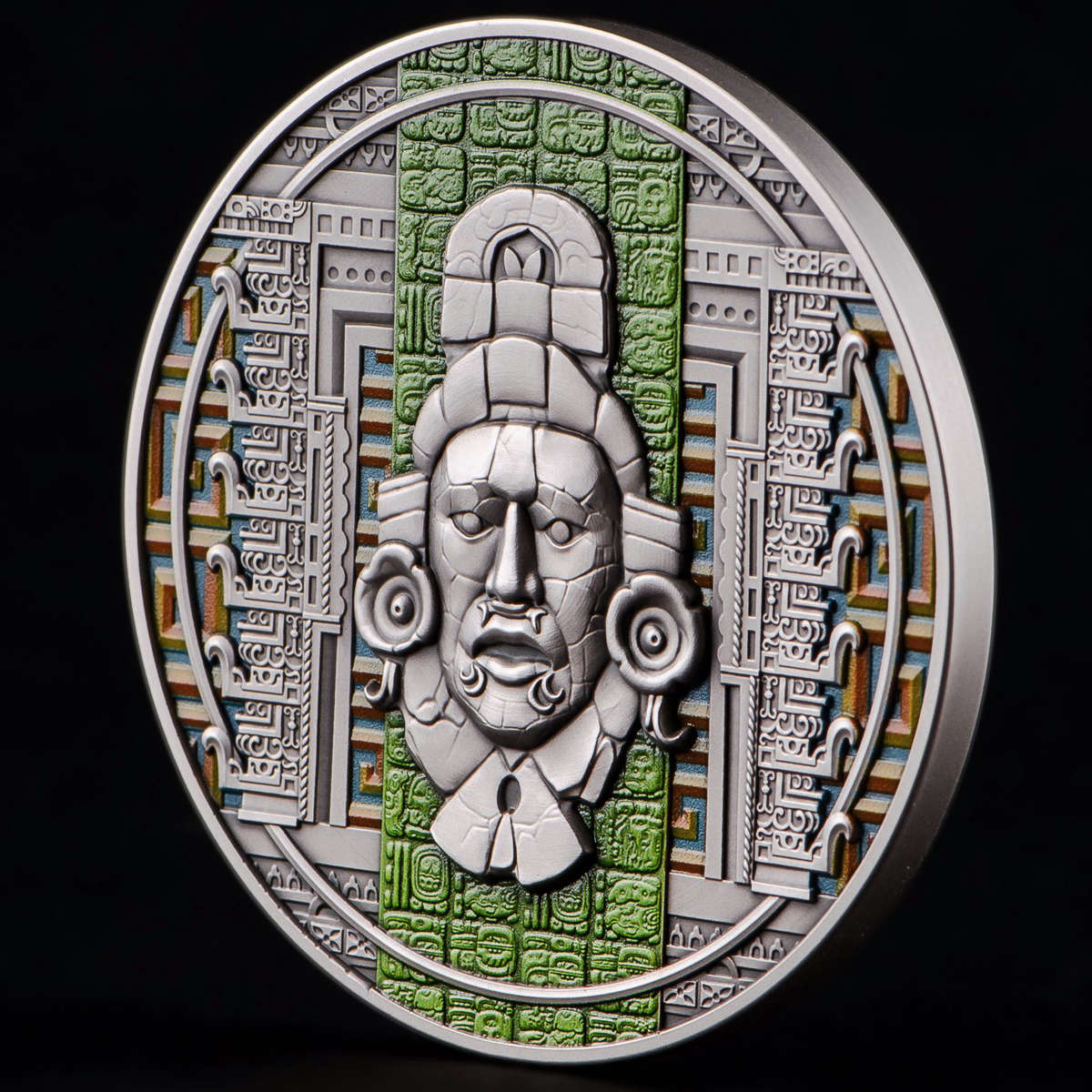
The range has a fixed design ethos, centred around a famous artefact. Here, it’s the Mayan Mask of Calakmul, one of the last, and most powerful of the city states. Uncovered in Calakmul in 1984, in what was designated ‘Structure 2B’, a large pyramid, this 7th-century funerary mask was formed from 57 hand-cut jade tiles, with obsidian and seashell adornments. It was found next to the skeletal remains of Yuknoom Yich’aak K’ahk, the king of the Kaanu’l Dynasty, who had the city as his capital. It can be seen in the Museo de Arquitectura Maya at the Baluarte de la Soledad in Campeche.
Behind the artefact is a coloured vertical area filled with Mayan glyph script. Behind that is a mix of Mayan architecture, and patterns, the latter coloured. The common obverse returns. The coin is issued for Cameroon, whose national shield is located at the centre, circumnavigated by the issue inscriptions. Around this, are seven concentric rings of script, and the Mayan characters are instantly recognisable in the fifth ring out from the centre. The sixth ring tells us the next coin will be Greece, and then the outermost ring, Roman.
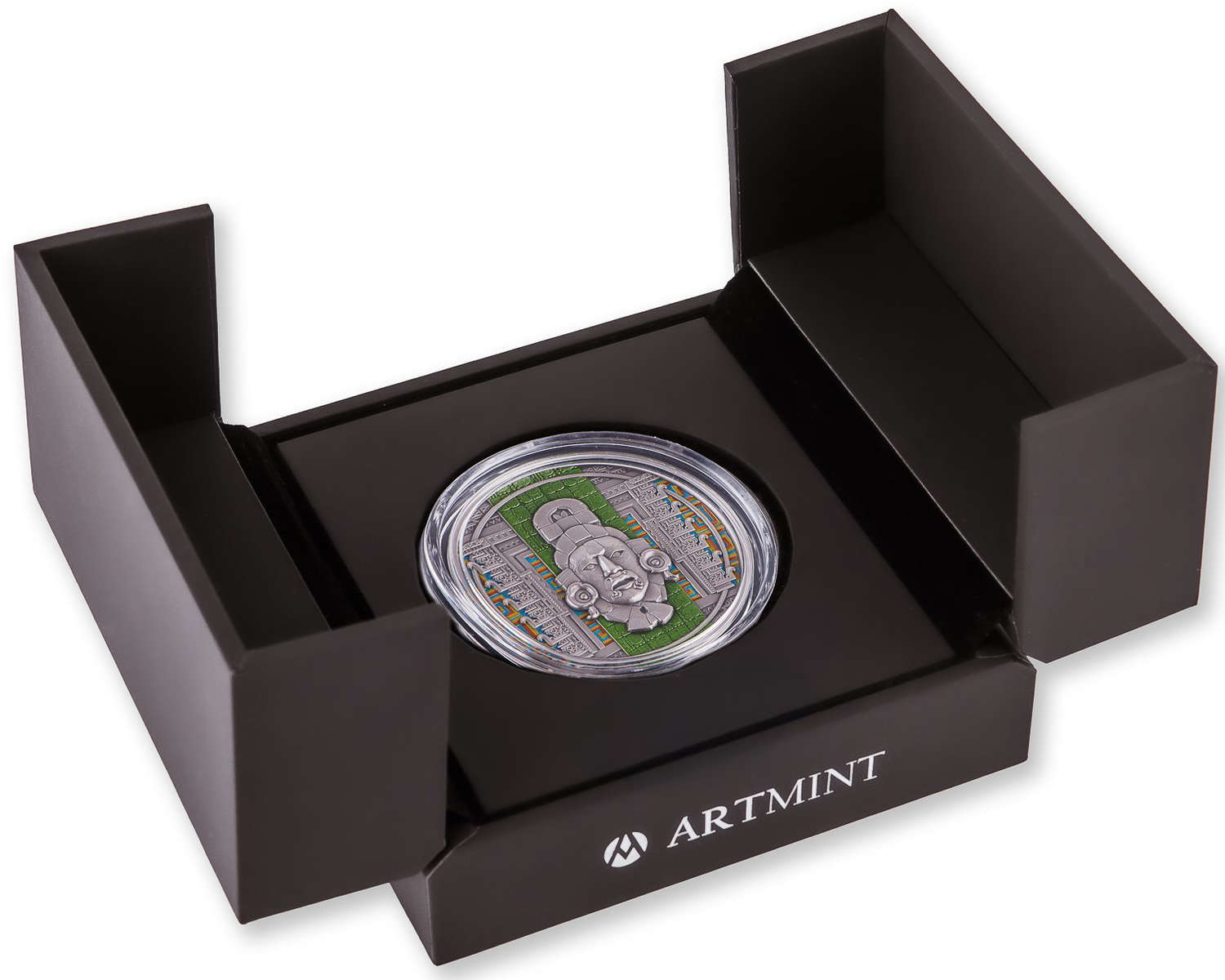
Archaeological coins always get a thumbs up here, especially when they’re as well researched and attractive as this series is. The Mayan coin is a fine addition, probably my second favourite after the debut Sumerian issue (although I’m biased after a walk through Berlin’s museums, which are full of Sumerian and Assyrian objects). It comes boxed, with a certificate of authenticity, and only 300 of these will be struck.
GALLERY

05: MAYA

04: CHINA

03: EGYPT

02: INDUS VALLEY

01: SUMERIA
| DENOMINATION | COMPOSITION | DIAMETER | FINISH | MINTAGE |
| 2,000 Francs CFA (Cameroon) | 62.2 g of 0.999 silver | 50.0 mm | Antique, Colour | 300 |
Leave A Comment